
Runway Sizing Isn’t As Simple As It Seems
Goldilocks is famous for finding the perfect porridge, chair and bed that was just right. She’s also famous for breaking and entering, theft, and vandalism but we’ll leave those issues for another day. Anyway, airport runway sizing should have a similar Goldilocks philosophy, runways should be just the right size and right surface for the intended user. In this article, we’ll talk about how to size an airport runway appropriately, primarily using FAA guidance.

Have you ever landed on a short, narrow runway with a steady 12 knot crosswind then wondered why your shirt was soaking wet as you tied down your plane? Or maybe you’ve landed on an enormous runway where you couldn’t see the other end of the pavement as you touched down and you were pretty sure you could have landed on the runway at a 90 degree angle because it was so wide?
I definitely prefer the latter situation, I mean, my deodorant can only do so much. Sometimes runways are limited in size because they are expensive and the airport owner may have only been able to afford a certain size of runway. At other airports, maybe land or terrain constraints limit the size of a runway. For our explanation purposes, we’re going to make some assumptions:
First – that money is no object and the airport will be able to fund the proper size runway.
Second – that land and terrain constraints are not a factor.
And third – we’ll use FAA standards to determine runway sizing. We’ll be using several different FAA Advisory Circulars (AC) to help us understand runway sizing standards:
AC 150/5000-17, “Critical Aircraft and Regular Use Determination”
AC 150/5300-13B, “Airport Design”
And
AC 150/5325-4B, “Runway Length Requirements For Airport Design”
In many cases, it may also be beneficial to use the Airport Master Plan Advisory Circular (AC 150/5070-6B) to help identify both current and future users of the airport.
If federal grants are used to fund runway development, these advisory circulars are mandatory, for projects that don’t use federal funds, these AC’s are recommended.
It’s important to know that there is no “one size fits all situation” for runway sizing, in general, runways are designed to accommodate the critical aircraft.
Additionally, this article is based on the methodology used for sizing of all runways. The FAA is currently developing an electronic tool to help size runways for airports that primarily serve smaller aircraft. More on this new methodology at the end of this article.
As mentioned earlier, we use AC 150/5000-17 to help determine the runway critical aircraft.
So exactly what is the critical aircraft you ask? Good question, the AC defines critical aircraft as:
“the most demanding aircraft type, or grouping of aircraft with similar characteristics, that make regular use of the airport. Regular use is 500 annual operations, including both itinerant and local operations but excluding touch-and-go operations. An operation is either a takeoff or landing.”
It’s important to note that a separate Critical Aircraft determination is required for each runway if the airport has more than one runway.
There are times when a critical aircraft will be identified as a specific airplane, such as a Pilatus PC-12 or Gulfstream G650 for example, while other times it may make more sense to identify a group of aircraft with similar characteristics. Similar characteristics normally includes similar wingspans and approach speeds. For the purposes of this explanation, we’ll look at a particular aircraft to simplify things.

The long and short of it is that we need to figure out what aircraft uses a particular runway for at least 500 operations per year. Sounds simple enough right? Well, not exactly. Counting actual operations of aircraft is easier said than done for a number of reasons. First of all, some smaller airports are not staffed very well or not at all, in these cases, there’s really nobody available to collect actual runway usage information. Some airports have more staff available but maybe those hours are only 8 am to 5 pm everyday so the operations outside of those hours may not be captured. Even at airports with a control tower, the operations per runway, along with aircraft type may not always be logged, plus many towers are not open 24 hours per day. So, you get the idea that operations counts cannot be developed from a single source. It takes a combination of several methodologies to get the most accurate operations data. As some may say, it takes a village…not Village People, that’s a whole ‘nother story.
Here are some ways that airports can get the most accurate operations data for their runways:
- Airport managers can keep a log of the operations that they observe, including which runway is used as well as the aircraft N-number to identify the aircraft type.
- Work with the Fixed Based Operators (FBO’s) on the airport to see if they have some sort of log available. Sometimes these logs are related to fuel purchased.
- Hire people temporarily specifically to count operations per airport, sometimes this can be for a limited time, then a formula can be derived to extrapolate the sample to reflect annual numbers.
- Gather all available data from the Air Traffic Control Tower (ATCT) if one exists.
- The FAA has several data sources available including those that track aircraft based upon ADS-B data. This generally does not capture 100% of the traffic as all aircraft are not required to install ADS-B depending on the type of airspace that they fly in.
- Hire outside vendor to consolidate all of these methods to give the best data as possible.
- The Airport Cooperative Research Program (ACRP) published a report titled “Evaluating Methods for Counting Aircraft Operations at Non-Towered Airports” that details several methods of traffic counting including automated acoustical counters, security/trail cameras and a combination of linked video footage with ADS-B data.
Using all of this information, an airport should be able to at least make an educated guess, heck, maybe even a fairly accurate declaration of the critical aircraft.
As you can see, counting traffic and the number of operations per runway is the most time consuming element of determining the proper runway size. In the real world, this task normally takes at least a year so that a true annual data set can be gathered.
Once the critical aircraft is identified, then we can see what category the airplane falls within. For this information, we need to look in AC 150/5300-13B, “Airport Design”. Specifically, we need to identify the critical aircraft approach speed, wingspan and in most cases the maximum takeoff weight.
This AC defines two important groups regarding aircraft, the first is the Aircraft Approach Category (AAC) and the second is the Airplane Design Group (ADG).
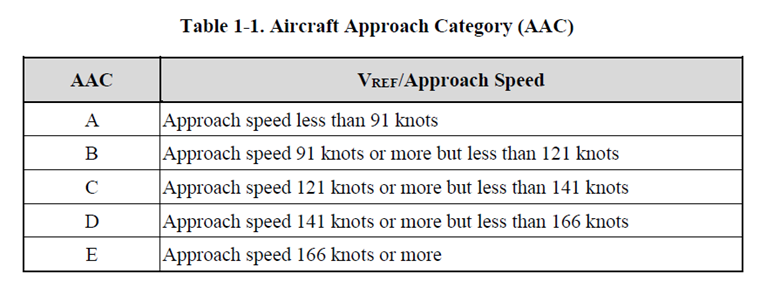
The AAC is related to the normal approach speed of an aircraft and is defined as “a grouping of aircraft based on a reference landing speed (VREF), if specified, or if VREF is not specified, 1.3 times stall speed (VSO) at the maximum certificated landing weight. VREF, VSO, and the maximum certificated landing weight are those values established for the aircraft by the certification authority of the country of registry.”
The AAC divides aircraft into 5 different categories:
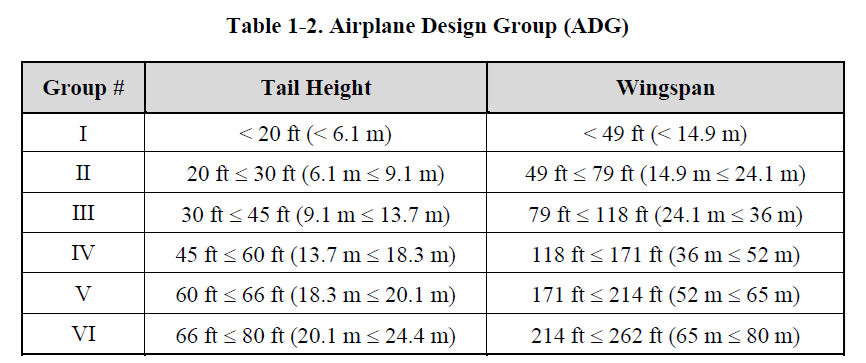
The ADG is related to the airplane wingspan and is defined as “A classification of aircraft based on wingspan and tail height. When the aircraft wingspan and tail height fall in different groups, the larger group applies.”
The ADG divides airplanes into 6 different categories:
To keep things simple, let’s assume that our diligent research has determined that a Hawker 800 business jet is the critical aircraft with over 500 operations on a runway. The Hawker is a mid-sized business jet and has an approach speed of 137 knots, a wingspan of 51.4 feet and a tail height of 18.1 feet. It also has a typical maximum gross takeoff weight of 28,000 pounds. I got these numbers from a spreadsheet that the FAA publishes on it’s website that has many different aircraft and their characteristics. Based on those numbers, the Hawker jet falls within approach category ‘C’ and design group 2.
Now that we have established the critical aircraft’s AAC and ADG, we can now use FAA Advisory Circular 150/5300-13B “Airport Design”, Appendix ‘G’ to get the standard runway dimensions for a C-2 aircraft. Now, this AC will only give us the standard runway width, we’ll need to look at a separate AC for runway length, more on that later.
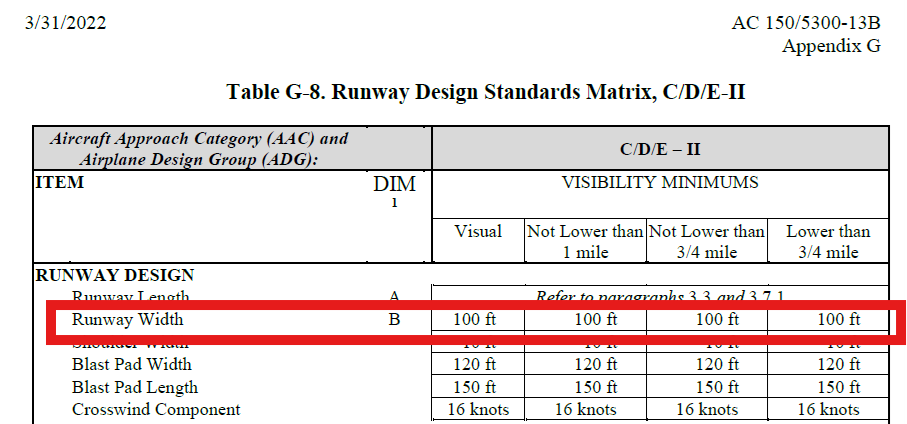
We find the standard runway design criteria for C-2 type aircraft in Table G8. The standard runway width is 100 feet. A 10 foot wide shoulder is also recommended for each side. The shoulder helps provide a buffer from the runway pavement to the grass or other material off the sides of the runway. Shoulders help to keep foreign object debris like dirt, rocks, grass clippings, etc off of the main runway pavement.
This appendix includes other tables as well for every combination of AAC and ADG so that airport designers can easily select the proper runway width for the critical aircraft.
I note that this entire exercise was done to determine only the existing critical aircraft. Many airports also need to plan for a future critical aircraft. The FAA states that, “The future Critical Aircraft is determined with an FAA-approved forecast that considers aircraft “highly likely” or “expected” to regularly use the airport”. However, current funding levels do not always allow airports to build today the infrastructure that is needed to accommodate expected airport growth. Remember, we assumed that money is no object in our analysis, so how can an airport best serve both the existing users as well as plan for expected users in the near future. The near future generally includes users expected to use the airport within the next 5 to 10 years. The key point here is that designing a runway for a future critical aircraft is dependent upon an FAA approved forecast. Forecasts take into account numerous factors when predicting future aviation activity including:
- Economic Characteristics, for the local area as well as regional and national trends.
- Demographic Characteristics
- Geographic Attributes
- Aviation-related Factors – What are the trends occurring in the marketplace?
- Other Factors such as economic actions such as fuel price changes, availability of aviation fuels, currency restrictions, and changes in the level and type of aviation taxes. Political developments, including rising international tensions, changes in the regulatory environment, and shifting attitudes toward the environmental impacts of aviation, may also impact future demand and should be considered in developing or updating airport forecasts.
It would take a series of blog posts to adequately discuss aviation forecasts, so for our example above, and for the sake of simplicity, let’s assume that the future critical aircraft is the same as the current critical aircraft, which is the Hawker 800 business jet.
OK, we know how wide the runway should be, but how long should it be? If you ask some pilots, they might say “As long as you can give me”. Yes, we’d all love to have that 10,000 foot runway on a hot summer day when we’re near max gross weight, unfortunately, that size of runway is not feasible or reasonable everywhere.
The best place to find answers is in Advisory Circular 150/5325-4B, “Runway Length Requirements For Airport Design”. We’ll want to focus on Chapter 3 which looks at aircraft between maximum takeoff weights of 12,500 pounds to 60,000 pounds as the Hawker jet has a maximum takeoff weight of 28,000 pounds.
Old vs New
The old runway length design exercise was a step by step process based upon length curves and airplane performance. We’ll look at this process in greater detail below. However, thanks to the wonders of 40 year old technology, the FAA has recently adopted a computer software approach to calculating runway lengths per an upcoming program called SARLAT (Small Aircraft Runway Length Assessment Tool). That’s much better than the acronym I would have used, ATYOD (About Time You Old Dinosaurs).
Let’s take a look at the old methodology in greater detail.
Step 1 – Determine the critical aircraft – this step has already been completed, it is the Hawker 800.
Step 2 – Identify the weight class of the aircraft – again this step has already been completed as the Hawker weighs between 12,500 lbs and 60,000 lbs.
Step 3 – Decide which charts to use based upon the family of aircraft, the proper charts to use in this case send us to Chapter 3 of the AC.
Step 4 – Use the chart to determine the recommended runway length, more on this in a minute.
Step 5 – Determine if any adjustment factors are necessary based upon the runway gradient. Flat runways do not require any adjustment.
Let’s look at Step 4 in closer detail. For the purposes of our example, we’re going to use the chart found in Figure 3-2 of the AC.
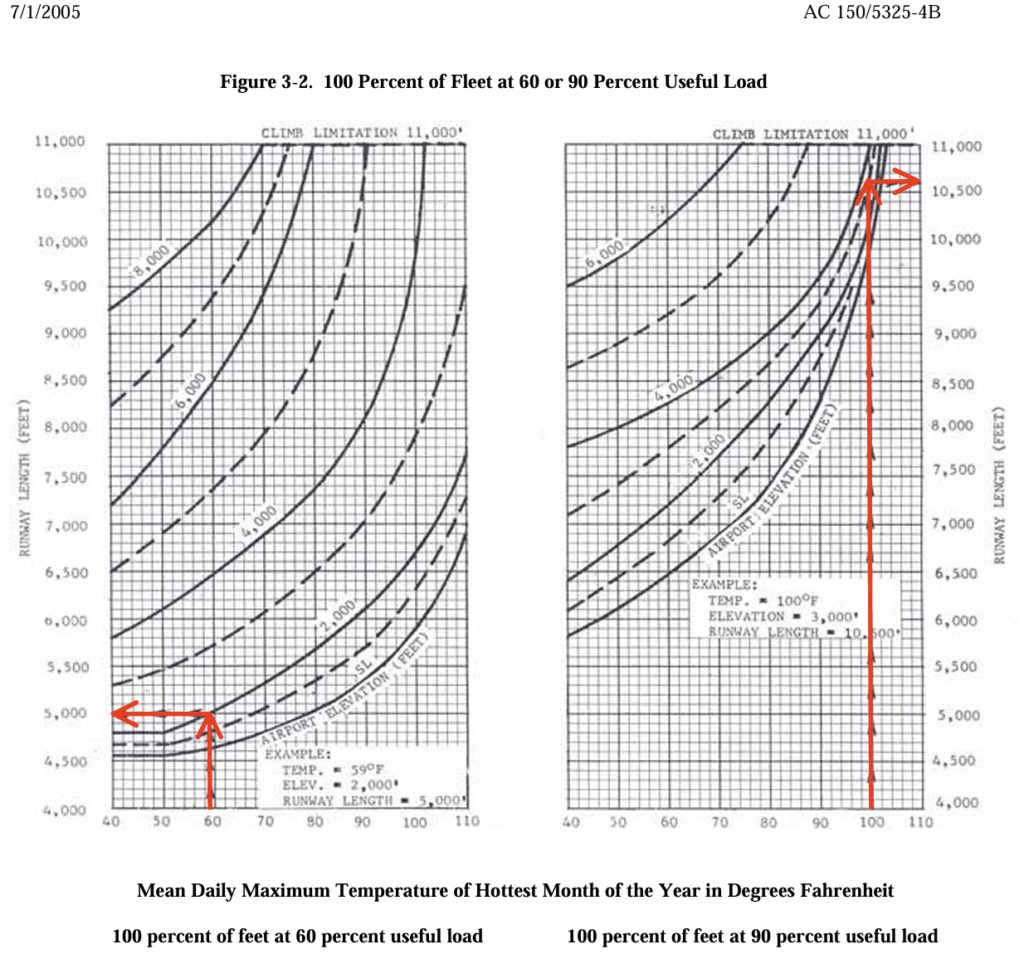
We now need to make a few additional determinations, here they are in order to simplify our review:
First – We see from Table 3-2 that since the Hawker 800 is the critical aircraft, we need to use the Chart in Figure 3-2 that provides for 100% of the aircraft fleet.
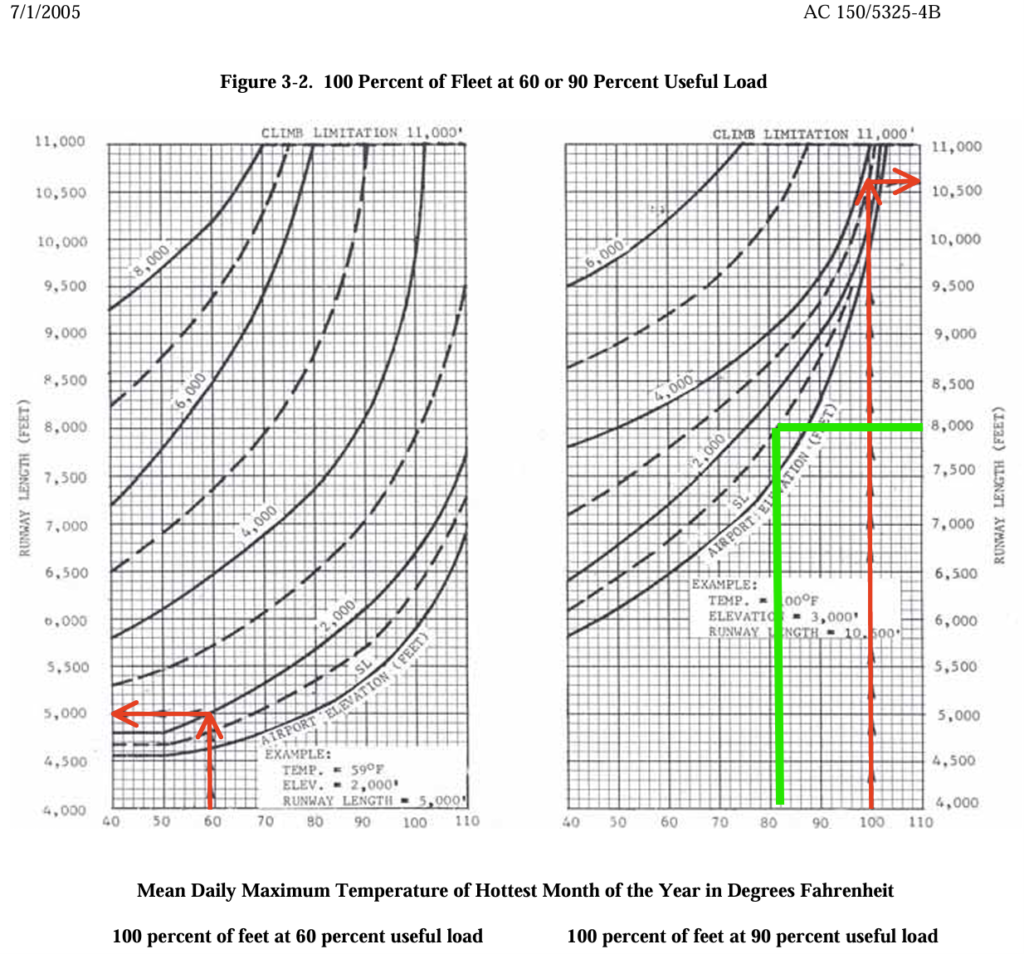
Second – Let’s assume that from our research on the users of the Hawker 800, they normally operate at 90% useful load.
Third – The airport in our example sits at 1,000 feet AMSL.
Fourth – The Mean Daily Maximum Temperature of Hottest Month of the Year in Degrees Fahrenheit at the airport is 82.
OK, now given those factors, we can use the chart to determine that the runway length should be 8,000 feet. This is shown by the green lines in Table 3-2 below:
Phew, that was a piece of cake right?
Well, we’re not quite finished, remember the adjustment factors I mentioned earlier? Two of those adjustment factors are:
- Runway surface condition for runways serving jet aircraft (is it wet or slippery?)
- Runway centerline gradient
The AC states that we consider wet runway conditions for only landing operations and only for turbojet-powered airplanes. The runway length we determined earlier must be increased by 15% for wet conditions according to the AC.
So if we increase the 8,000 foot long runway by 15%, that is 1,200 feet.
For our example, let’s also assume that the runway centerline has 20 foot elevation difference between it’s low point and it’s high point. This leads to another length adjustment factor we need to consider.
According to the AC, for airplanes over 12,500 pounds maximum certified takeoff weight, the recommended runway length for takeoff must be increased by 10 feet per foot of difference in centerline elevations between the high and low points of the runway centerline elevations. Since we have a 20 foot difference in runway centerline we multiply that by 10 to get an additional 200’ of needed runway length.
The AC tells us that we should take whichever adjustment factor is the greatest and use that number. In our example, the wet runway adjustment factor adds 1,200 feet to the runway, while the elevation difference adjustment factor only adds 200 feet to the runway.
So for our example, we’ll use the larger 1,200 foot adjustment factor, add that to the 8,000 foot runway already identified from the graph and the total runway length is now 9,200 feet long.
Are we done? Yes! We’ve reached the finish line for the old method. I’m guessing that you can see that although there are many steps to this process, there are a few steps that introduce uncertainty, especially reading those darn graphs produced sometime when disco was king.
New Method
Now, let’s take a look at the new method of calculating runway lengths using the SARLAT method. Please don’t confuse this tool with the giant underground beast on Tatooine called a Sarlacc.
SARLAT was first introduced by the Airport Cooperative Research Program Report 03-54, General Aviation Airports Runway Length Analysis in 2022. After a few years of fine tuning and development, the FAA is poised to release an electronic SARLAT tool in 2026.
I’ll detail all of the features of this new tool in a separate article once it is released.