
Airport Pavement Design 101
One of my favorite shows on TV is the “Great British Baking Show” or the “British Bake Off” as they call it in the UK. I enjoy the skill with which the amateur competitors bake and for some reason I’m always hungry after watching it. During pastry week, the judges and the contestants are constantly concerned about getting enough layers in their dough, it’s all about the layers. In addition to layers, judge Paul Hollywood is often fixated on the height of the pastry and the dreaded soggy bottom. Now, just imagine for a second that I replace the word “pastry” with “airport pavement” and engineer Paul Hollywood would have the same concerns. What are the right amount and types of layers in the pavement section? Is it high or thick enough? And we certainly don’t want to start with a soggy bottom. We’ll get into all these details, using FAA design principles as the basis for our airport pavement.

Unlike my favorite pastry layers, which should be light, flaky and delicious, airport pavement layers should be strong, well drained and … let’s just say you wouldn’t want to eat them.
For our discussion, we’ll use FAA’s advisory circular 150/5320-6G, “Airport Pavement Design and Evaluation”. In addition to this guidance document, the FAA also provides a computer program called FAARField that helps pavement designers experiment with layer types and thicknesses fairly quickly to select the best pavement structure for the situation. The FAA also provides a whole training video series on how to use FAARField.
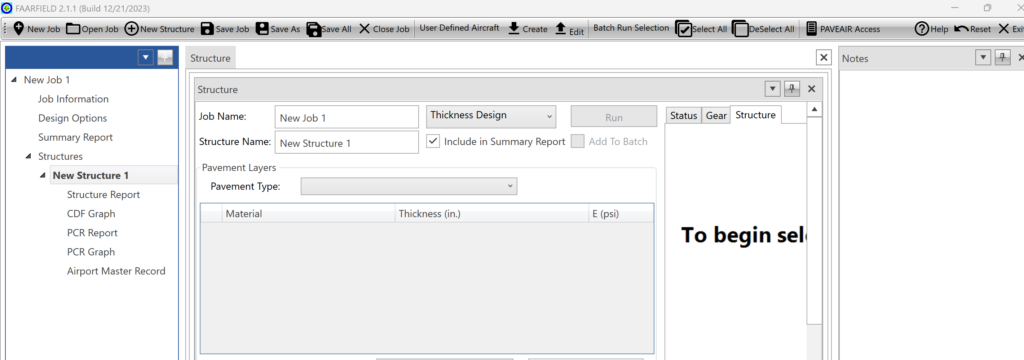
There are year-long classes in college that discuss pavement design so there’s only so much I can cover in one article but we’ll do our best to cover the basic concepts.
Key Design Components
Airport pavement analysis and design involves the interaction of four equally important components:
1. The subgrade (which is the naturally occurring soil),
2. The paving materials (surface layer, base, and subbase),
3. The characteristics of applied loads (aircraft weight, tire pressure, location and frequency), and
4. Climate (what are the high/low temperatures, the amount and frequency of rainfall/snowfall).
We’ll talk about each of these in more detail later.
Airport pavements are asked to do a lot. An Airbus A380 has a gross maximum takeoff weight of about 617 tons, compare that to the heaviest truckload allowed on the US interstate system which is 40 tons. So in theory, the strongest airport pavement needs to be 15 times stronger than highway pavement.
Airport pavements are designed and constructed to provide adequate support for the loads imposed by aircraft and to produce a surface that is: firm, stable, smooth, skid resistant, a year-round all-weather surface, free of debris or other particles that can be blown or picked up by propeller wash or jet blast.
So in general, airport pavement is like the Veg-O-Matic of pavements, it slices, it dices it makes cappuccino!
Pavement Types
There are two basic types of airport pavement: the first is flexible pavement, which is normally some type of asphalt, and the second is rigid pavement which is usually concrete.
Ideally, airport pavements should last at least 20 years before needing a reconstruction. So how does a pavement designer decide on whether to use asphalt or concrete?
The selection of a pavement section requires the evaluation of multiple factors including cost and funding limitations, operational constraints, construction timeframe, material availability, cost and frequency of anticipated maintenance, environmental constraints, future airport expansion plans, and anticipated changes in traffic. So you can see, it’s not just as simple as flipping a coin to decide what type of pavement to use. I have seen both types of pavement last well beyond their projected 20 year useful and I’ve also seen the early demise of both pavement types. One key factor in making sure pavement has the best chance to reach a 20 year life is to maintain it properly. We’ll talk a bit more about proper maintenance later.
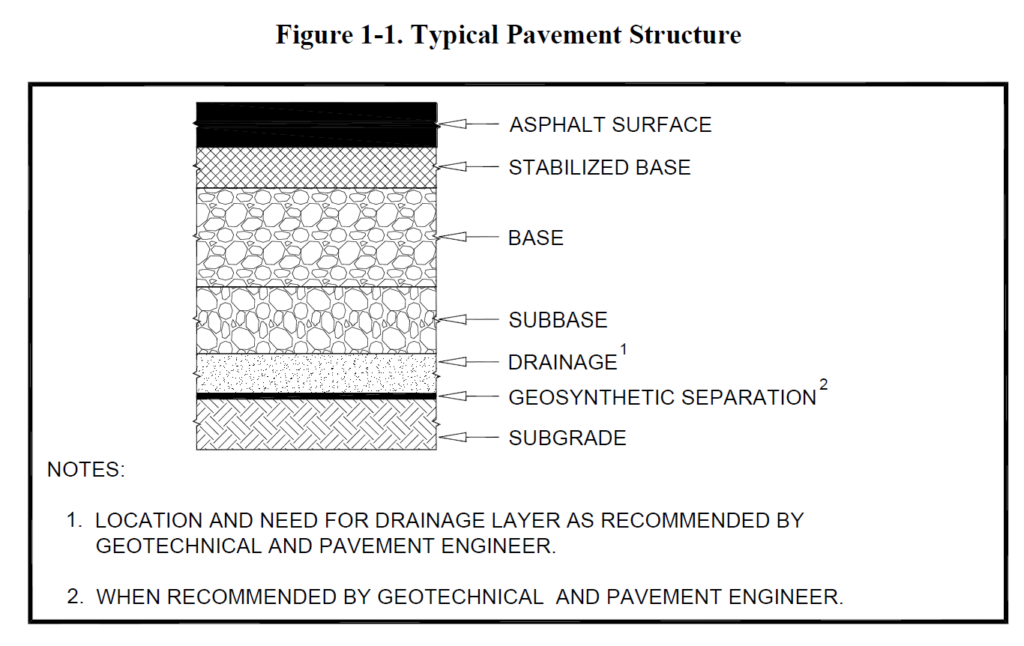
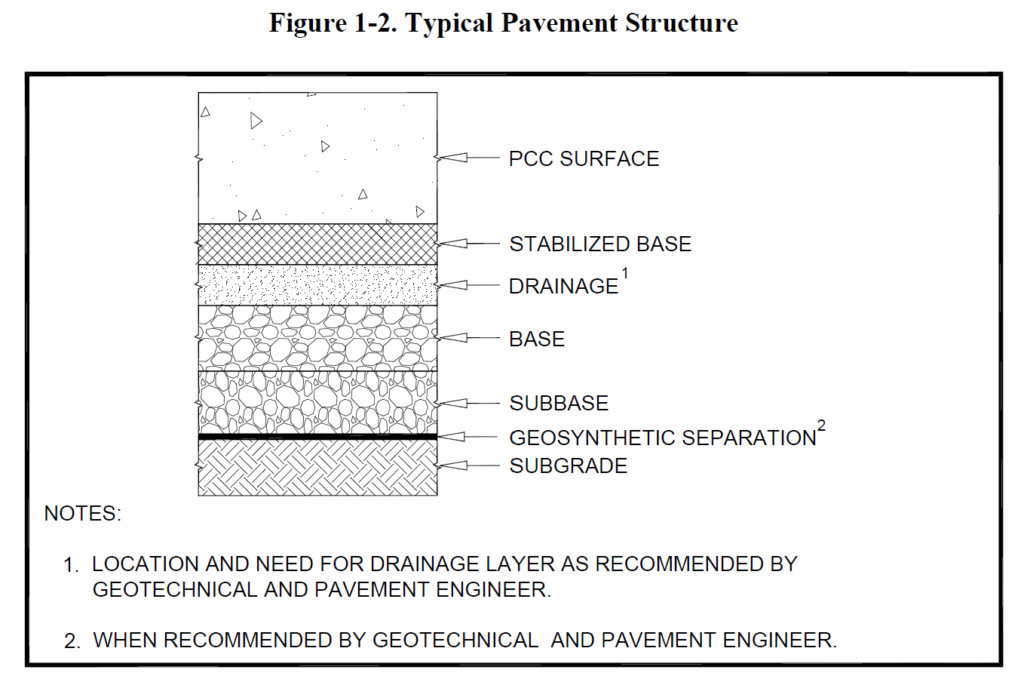
Regardless of the pavement type selected, the typical pavement section, or the layers, consist of:
- The surface course – this is the top layer that we see on the ground, once again this is usually asphalt or concrete.
- Just below the surface course is the base course which usually consist of aggregate or gravel-like material.
- Below the base course is the subbase course which normally consists of granular material, many times this is some sort of sand-like material.
- The bottom layer of pavement is the subgrade which can be the natural soil or modified soil.
One of the most unique pavement sections I have ever encountered was when I was looking at an engineering report with pavement cores on a very old runway. Pavement cores are used to sample and survey existing pavement & soil conditions to determine the strength and properties of the existing site conditions. A drilling rig is used to cut out a small sample of the existing pavement and ground, then taken to a lab to determine the properties. Anyway, the core that caught my attention on this old runway indicated 3 inches of asphalt on a layer of turf. Yes, you heard that right, someone decided the best pavement section would be to just pave right over the grass. I guess somebody was tired of mowing grass and thought taking care of pavement would be easier.
Soil & Subgrade
Speaking of soil conditions and properties, if you recall earlier, I spoke about the 4 important aspects of pavement design, the first of which is the soil or subgrade properties. Let’s look at this component in more detail.
There are many enemies to strong pavements, and two of them are prevalent in the subgrade. The first is a weak subgrade and the other is water. Water is also my enemy every spring when my basement sump pump decides to die at 3 AM. The pavement subgrade is like the foundation of the pavement so it needs to be suitable to support the layers above it and not retain too much water. I don’t know of too many floating skyscrapers or buildings built on quicksand, pavement construction has the same principle of needing a good foundation to build on.
So sit back, relax and get ready for 50 more pages of in-depth geotechnical engineering minutiae…just kidding, I’ll do my best to simplify the main ideas of ensuring a suitable subgrade foundation for airport pavement.
As mentioned earlier, we generally need to start examining the quality of the subgrade by getting real world data through pavement cores, soil samples/borings, soil maps and aerial photography.
The initial step in an investigation of subsurface conditions is a soil survey to determine the quantity and extent of the different types of soil, the arrangement of soil layers, and the depth of any subsurface water. Profile borings will assist in determining the soil or rock profile and its lateral extent. Due to variations at a site, the spacing of borings cannot always be definitively specified by rule or preconceived plan. Due to this potential variability, it’s important to take sufficient borings to identify the extent of soils encountered.
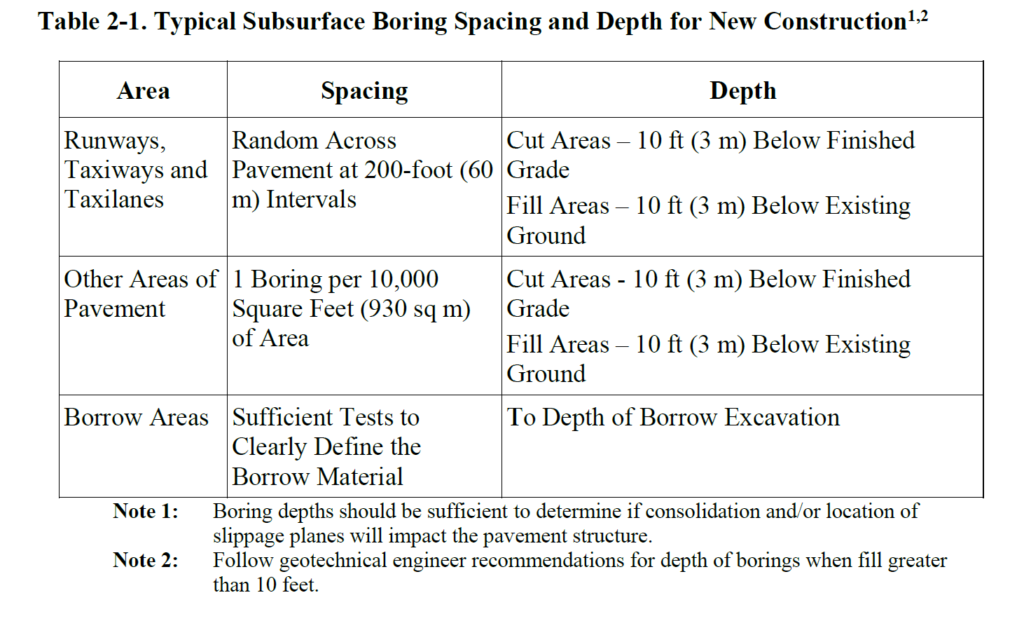
The samples are then studied in a lab to determine the properties of the existing soil. Some of these properties include:
- Particle size
- Plasticity index – which indicates the range in moisture content over which a soil remains in a plastic state prior to changing into a liquid, just think, quicksand = bad foundation.
- And compaction characteristics – just think, do I want to try to compact a soil that acts like Silly Putty? Probably not.
A key idea when thinking about the suitability of the subgrade is that improving weak subgrades may be more cost effective than providing thicker layers above it.
To help determine the actual strength of the subgrade, there are two separate lab tests often performed.
First, for asphalt pavement, the California Bearing Ratio or CBR is determined. Please note that I said C-B-R, Charlie Bravo Romeo and not PBR, Pabst Blue Ribbon. That type of test reveals completely different results.
And second, for concrete pavement, the soil strength is determined using a plate load test.
Please don’t ask me why the plate load test didn’t get a cool acronym.
If the subgrade is unsuitable, which normally means the CBR is below 5, then the subgrade should be stabilized or removed and replaced with better material.
Subgrade stabilization can be done chemically (usually using cement or lime, kind of like a subgrade tequila), or mechanically (usually with rock bridges or geotextile fabric).
Climate
Closely related to the subgrade, is another important component of pavement design, climate.
We need to look at the water table and the depth of normal frost penetration. Of course these parameters don’t always come into play for every airport, but where freeze/thaw events occur, these items are of critical importance.
Certain subgrade types are more susceptible to frost than others, but free water, available to freeze is one of the most important factors in the amount of damage that freeze/thaw cycles can do to pavement. In order to help reduce the amount of water available to freeze, it may be a good idea to install edge drains as well as a subsurface drainage layer in order to guide water away from the pavement.
High temperatures can be as much of a problem as low/freezing temperatures. How many times have you heard about “pavement buckles” occurring during those dog days of summer? As pavement heats up, it expands, sometimes to the point where there is no place to go but up, which creates that pavement buckle. These types of events are not great for spindly aircraft landing gear, needless to say but I’m saying it anyway. The best way to try to address these occurrences is with properly spaced joints and or high temperature tolerant pavement materials.
Pavement layers and loading
The other two components I brought up at the beginning of the show are the layer types and the weight or loads that will need to be supported. We can look at these together to see how they affect pavement design.
Here is where things get really interesting, but also much simpler than say 40 years ago when much of this design work was being done by hand. Thank goodness for computers is all I have to say. Here is how the FAA describes the pavement design methods that are used in their FAARField program:
“The FAA developed FAARFIELD using failure models based on full-scale tests conducted from the 1940s through the present. Design thicknesses in FAARFIELD are calculated using layered elastic and three-dimensional finite element-based structural analysis for flexible and rigid airfield pavements respectively.”
Now, it’s been over 30 years since I took Calculus and Differential Equations in college, both classes I barely scraped by with passing grades so having a computer program do many of these calculations for me is a true gift.

In the past, airport pavement design centered on identifying the “design aircraft” kind of the “one aircraft to rule them all” which would normally be the heaviest or most likely to do the most damage to pavement. With the introduction of the FAARField program, this “design aircraft” concept has been replaced in favor of a Cumulative Damage Factor or CDF that takes into account all of the expected traffic that a pavement is likely to see. At some smaller northern airports for example, the snow removal equipment may be a large contributor to pavement damage rather than the aircraft alone. CDF is defined as the amount of structural fatigue life of a pavement that has been used. It is expressed as the ratio of applied load repetitions to allowable load repetitions to failure.
In order to correctly identify the CDF, the pavement designer will need to have a good understanding of the types of aircraft that will be using the airport and how often those aircraft will operate. A detailed airport forecast is often necessary prior to entering the values in the FAARField program.
Another key point is that FAARField does not take into account frost protection requirements, that must be reviewed and accounted for separately.
The proposed pavement section is designed in the FAARField program using the following seven steps:
- Select the type of pavement (flexible or rigid)
- Modify the pavement structure by adding, deleting or changing layers as needed.
- Create a traffic mix by selecting a stored mix, or by picking aircraft from the aircraft library.
- If necessary, change the gross weight or number of departures of aircraft in the traffic mix. The gross weight is normally related to the maximum takeoff weight of an aircraft.
- Run Thickness Design.
- Run Compaction/Life to obtain subgrade compaction requirements for new pavement construction.
- View or print the section design report.
According to Table 3-3 in AC 150/5320-6G, there are minimum thicknesses for flexible pavement structures. These are the minimums and may go up from there based upon traffic mixes and the quality of the subgrade at the site.
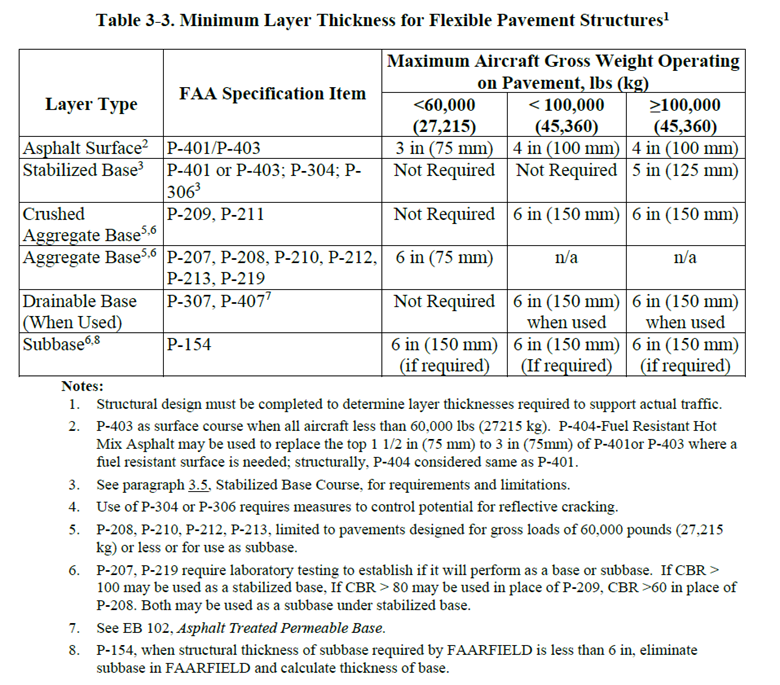
For flexible pavements expected to serve aircraft generally less than 60,000 pounds, the minimum pavement section consists of a 6” aggregate subbase, a 6” aggregate base and a 3” asphalt surface course, for a 15” total pavement section. This pavement is typical for many general aviation airports that are designed to serve common GA aircraft.
For flexible pavements expected to serve aircraft weighing between 60,000 and 100,000 pounds, the minimum pavement section is a 6” aggregate subbase, a 6” drainable base, a 6” crushed aggregate base and a 4” asphalt surface course for a 22” total pavement section. This type of pavement is typical at larger GA airports that see some heavier corporate jet use.
For flexible pavements expected to serve aircraft greater than 100,000 pounds, the minimum pavement section is a 6” aggregate subbase, a 6” drainable base, a 6” crushed aggregate base, a 5” stabilized base and a 4” asphalt surface course for a 27” total pavement section. This type of pavement is typical at large reliever and commercial service airports.
Now, for rigid, concrete pavements, Table 3-4 identifies the following minimum pavement thicknesses:
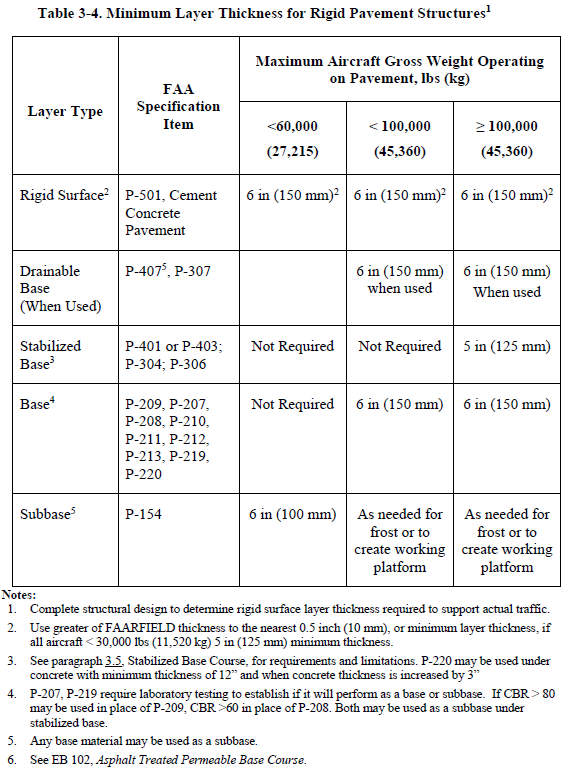
For rigid pavements expected to serve aircraft generally less than 60,000 pounds, the minimum pavement section consists of a 6” subbase and a 6” concrete surface course, for a 12” total pavement section.
For rigid pavements expected to serve aircraft weighing between 60,000 and 100,000 pounds, the minimum pavement section is a 6” aggregate base, a 6” drainable base, and a 6” concrete surface course for a 18” total pavement section.
For rigid pavements expected to serve aircraft greater than 100,000 pounds, the minimum pavement section is a 6” aggregate base, 5” stabilized base, a 6” drainable base and a 6” Concrete surface course for a 23” total pavement section.
Remember that all of these are minimum recommended thicknesses, many larger airports that handle heavy commercial aircraft have pavement thicknesses greater than 30” in order to handle the heavy loads. The exact thickness is dictated by the FAARField program based upon the factors we have already discussed like soil suitability and the CDF.
Maintenance
Ok, so let’s assume that we’ve done a proper pavement design, the construction was flawless and we have a beautiful new runway, we’re done right? See you in 20 years guys! Unfortunately the answer is no. Now the fun task of maintaining that pavement begins. As somebody who has lived in houses with either asphalt or concrete driveways, I can attest to the need of maintaining each type of pavement material.
Here are a few things to think about when considering pavement maintenance:
- The earlier you start maintenance techniques the better.
- Maintenance is necessary to minimize damage caused by both loading and the environment (e.g. climate, temperature, moisture and exposure to sun). Many pavements deteriorate more from environmental distress than from structural loading.
- Timely crack sealing and application of surface treatments on flexible pavements is a cost-effective method to extend a pavement’s functional life. Surface treatments are more effective the sooner the treatment is applied. Surface treatments may be applied any time after initial construction but often the first surface treatment is applied 5 years after initial construction. A flexible pavement constructed with quality materials and quality construction that is maintained with timely crack sealing and surface treatments can last beyond the 20-year structural life.
- Timely resealing of joints on rigid pavement to keep water and incompressible material out of joints will extend the functional life of rigid pavements. Timely repair of spalling with partial depth repairs will extend the functional life of rigid pavements. The surface profile of rigid pavements can be restored with diamond grinding.
Final thoughts
Just a few other nuggets of info to keep in mind.
- Pavement shoulders are often not full strength pavement nor are they required to be. So if you fly a heavier aircraft, it’s probably a good idea to keep it within the lines of whatever pavement you are on and avoid the shoulders.
- Water is no friend of pavement and it can find ways into the pavement section in many ways, mostly through cracks in the surface course. If your airport ever has a “Let’s Fill Our Cracks Day”, I would encourage you to participate.
- Fuel is also no friend to pavement, please don’t dump fuel samples on the pavement, I recommend the fuel sample cups that allow you to examine the fuel, then pour the good fuel back into your tank.
That’s all for today, hopefully the next time you grease a landing, you can impress your passengers by spouting off some of these awesome pavement design facts.